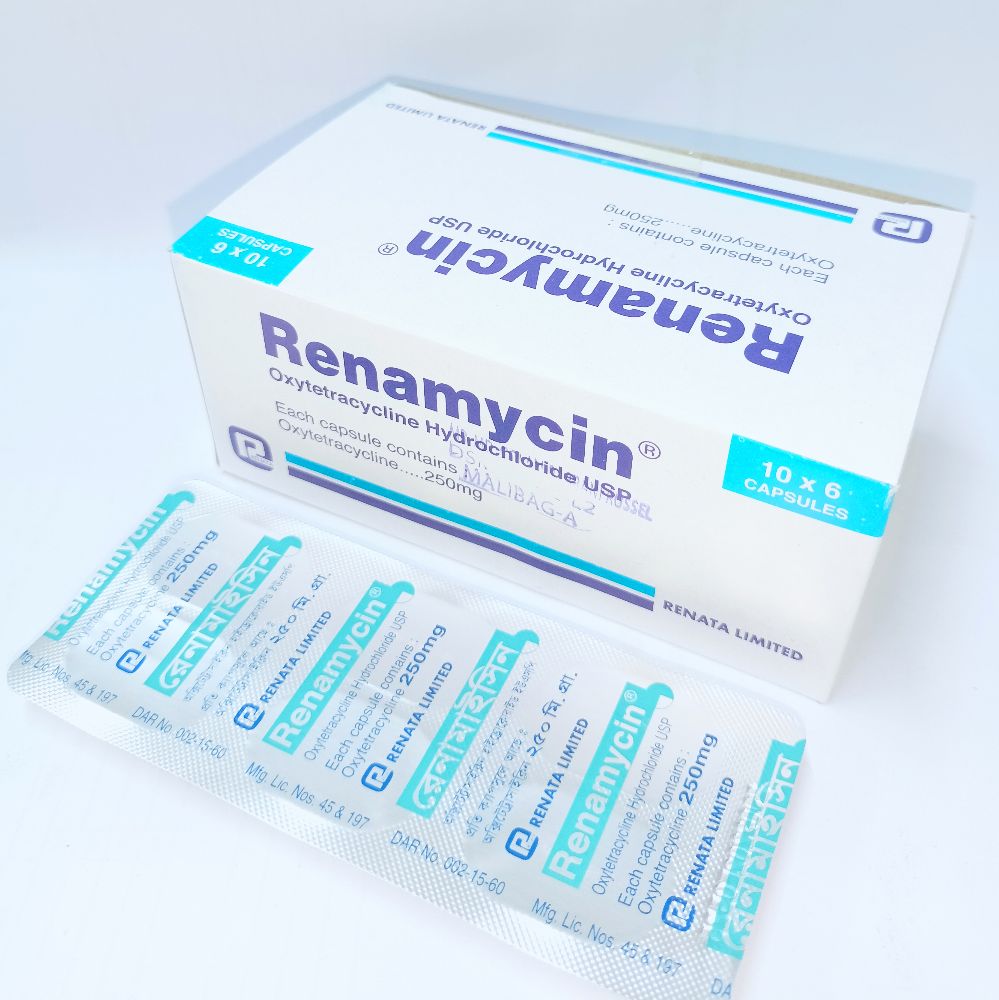
Renamycin50mg/ml
Type:10ml vial
Generic Name:Oxytetracycline
Manufacturer:Renata Limited
Price:৳16.19

Indication
Acne, Susceptible infections, Uncomplicated gonorrhoea
Administration
Should be taken on an empty stomach. Take on an empty stomach 1 hr before or 2 hr after meals.
Adult Dose
Oral Susceptible infections Adult: 250-500 mg 4 times daily. Max 4 g daily. Acne Adult: 250-500 mg bid. Uncomplicated gonorrhoea Adult: 1.5 g initially, followed by 0.5 g four times daily up to a total of 9 g per treatment course. Intramuscular Susceptible infections Adult: 250 mg once daily or 300 mg daily in 2-3 divided doses.
Child Dose
Oral Susceptible infections Child: >8 yr: 25-50 mg/kg daily in 4 divided doses. Intramuscular Susceptible infections Child: >8 yr: 15-25 mg/kg (max 250 mg) daily in 2-3 divided doses.
Renal Dose
Renal impairment: Dosage may need to be reduced.
Contraindication
Hypersensitivity to tetracyclines, children <8 yr, renal damage. Pregnancy, lactation.
Mode of Action
Oxytetracycline binds reversibly to the 30S and possibly 50S ribosomal subunits, thus inhibiting bacterial protein synthesis and arresting cell growth. It is active against a wide range of gram-positive and gram-negative organisms.
Precaution
Elderly, renal or hepatic impairment; myasthenia gravis; lupus erythematosus, children <12 yr.
Side Effect
Anorexia, nausea, vomiting,diarrhoea, glossitis, dysphagia, photosensitivity, oesphageal irritation and ulceration, nephrotoxicity, enterocolitis, rash (rare), blood dyscrasias. Headache, visual disturbances; intracranial hypertension; bulging fontanelles (infants). Potentially Fatal: Rare. Fulminant diarrhoea in post operative patients.
Interaction
Antacids, iron, aluminum, calcium, magnesium, zinc salts reduce absorption. Concurrent use may cause increased levels of lithium, digoxin, halofantrine and theophylline; decreased concentrations of atovaquone. Increased risk of ergotism with ergot alkaloids. May cause failure of oral contraception. Potentially Fatal: Interferes with anticoagulant control. Nephrotoxic effects exacerbated by diuretics, methoxyflurane or other nephrotoxic drugs; avoid concurrent use with potentially hepatotoxic drugs. Increased incidence of benign intracranial hypertension with retinoids.