
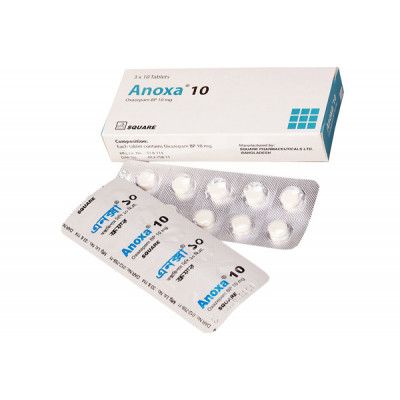
Anoxa10mg
Type:Tablet
Generic Name:Oxazepam
Manufacturer:Square Pharmaceuticals PLC.
Price:৳3.52

Indication
Anxiety, Insomnia, Alcohol withdrawal syndrome
Administration
May be taken with or without food.
Adult Dose
Oral Anxiety Mild/moderate: 10-15 mg 3-4 times/day. Severe, agitation or assoc with depression: 15-30 mg 3-4 times/day. Insomnia associated with anxiety Adult: 15-25 mg given 1 hr before bedtime. Alcohol withdrawal syndrome; Anxiety Adult: 15-30 mg 3 or 4 times daily. Elderly: Initially, 10 mg tid, increase up to 10-20 mg 3 or 4 times daily as necessary.
Child Dose
Oral Anxiety Child >12 years Mild/moderate: 10-15 mg 3-4 times/day. Severe, agitation or assoc with depression: 15-30 mg 3-4 times/day.
Renal Dose
Renal impairment: No dosage adjustment needed.
Contraindication
Not for the treatment of psychoses. Pregnancy and lactation. Hypersensitivity, Acute alcohol intoxication, Myasthenia gravis (allowable in limited circumstances) Severe respiratory depression, Depressed neuroses.
Mode of Action
Oxazepam is a short-acting benzodiazepine. It increases neuronal membrane permeability to Cl ions by binding to stereospecific benzodiazepine receptors on the postsynaptic GABA neuron w/in the CNS (including the limbic system, reticular formation) and enhancing the GABA inhibitory effects resulting in hyperpolarisation and stabilisation.
Precaution
Patient w/ CV or cerebrovascular disease, acute narrow-angle glaucoma, suicidal tendencies, history of drug abuse or acute alcoholism, myasthenia gravis, chronic pulmonary insufficiency or sleep apnoea. Not intended for treatment of psychoses. Avoid abrupt withdrawal. Hepatic and renal impairment. Elderly or debilitated patient. Pregnancy and lactation. Patient Counselling May impair ability to perform hazardous activities requiring mental alertness or physical coordination (e.g. operating machinery, driving). Monitoring Parameters Monitor resp and CV status. Periodic monitoring of CBC and LFTs. Lactation: Avoid during breastfeeding
Side Effect
Sleep and visual disturbances, drowsiness, dizziness, vertigo, lethargy, headache, tremor, ataxia, mild paradoxical reactions (e.g. excitement, stimulation of affect), minor diffuse skin rashes (e.g. morbilliform, maculopapular and urticarial), nausea, oedema, slurred speech, altered libido, GI symptoms. Rarely, transient anterograde amnesia or memory impairment, syncope, leucopenia and hepatic dysfunction including jaundice.
Interaction
Additive CNS depressant effects w/ barbiturates, antipsychotics, sedatives/hypnotics, anxiolytics, antidepressants, sedative antihistamines, anticonvulsants, and anaesth. Increased psychic dependence w/ narcotic analgesics. CYP450 inhibitors may enhance benzodiazepine activity.
